
The Roots of Chronic Autistic Burnout
A New App And A Nap Aren't Going To Cut It


Earlier we explored the emotional, cognitive, and physical state of Chronic Autistic Burnout (catch up here). This time, let’s dig into the weight of what we’re carrying so we might better lighten the load.
🤿 Want a deeper dive? Look for this scuba emoji. Feel free to skip these bits otherwise. All product links earn affiliate fees that directly support Autastic.
Give credit where credit is due
This isn’t on you.
Chronic Autistic Burnout isn’t down to your efforts, lack of willpower, or motivation. It’s about us paying, with our health, for our deeply ableist and racist societies’ utter and spectacular failures of recognition, acceptance, policy, and support.
Autistic Black and brown folk navigate multiple systemic prejudices daily. The costs of existing are compounded with our every intersectional identity. For all y’all in the comments all these years, screaming your heads off that autism has nothing to do with race, buckle in. I have some news: ableism and racism are birthed from the same colonial pastime of ranking of human value that plays out today in our everyday lives.1
🤿 Dr. Arline T. Geronimus coined the term “weathering” to describe “the accumulation and culmination of life experiences that are structured by historical and ongoing systemic racism and classism”. Does that apply to autism? Yep, sure does. Ableism factors into weathering as well and, surprising to no one, is often left out of the conversation.

Although autistic burnout is becoming more widely accepted, quantified, and understood as a real and distinct condition2, autistic people in mid-life and beyond—when our allostatic load has accumulated enough to be notable—remain largely missing from the conversation. This is most particularly true for people of color3. That means that those of us in Chronic Autistic Burnout are largely going unseen and unsupported.
Not news to y’all, I’m sure.
The price of admission
The fallout from chronic autistic burnout is far from personal and far from trivial.
👤 The price for individuals:
Being unable to identify what’s happening to their health and capabilities due to a lack of even marginally adequate widespread information4, particularly if they don’t yet realize they’re autistic.
Getting few clear answers from healthcare providers.
Receiving misdiagnoses and treatments5 for conditions such as Depression, Anxiety, Bipolar II, Borderline Personality Disorder, Mood Disorders, etc.
Developing secondary depression and anxiety after years of dismissal and erasure.
Losing employment, relationships, and hope as recovery remains elusive.
The entire situation is corrosive to our bodies, minds, and spirits. We’re not just tired. We are mentally and physically depleted.
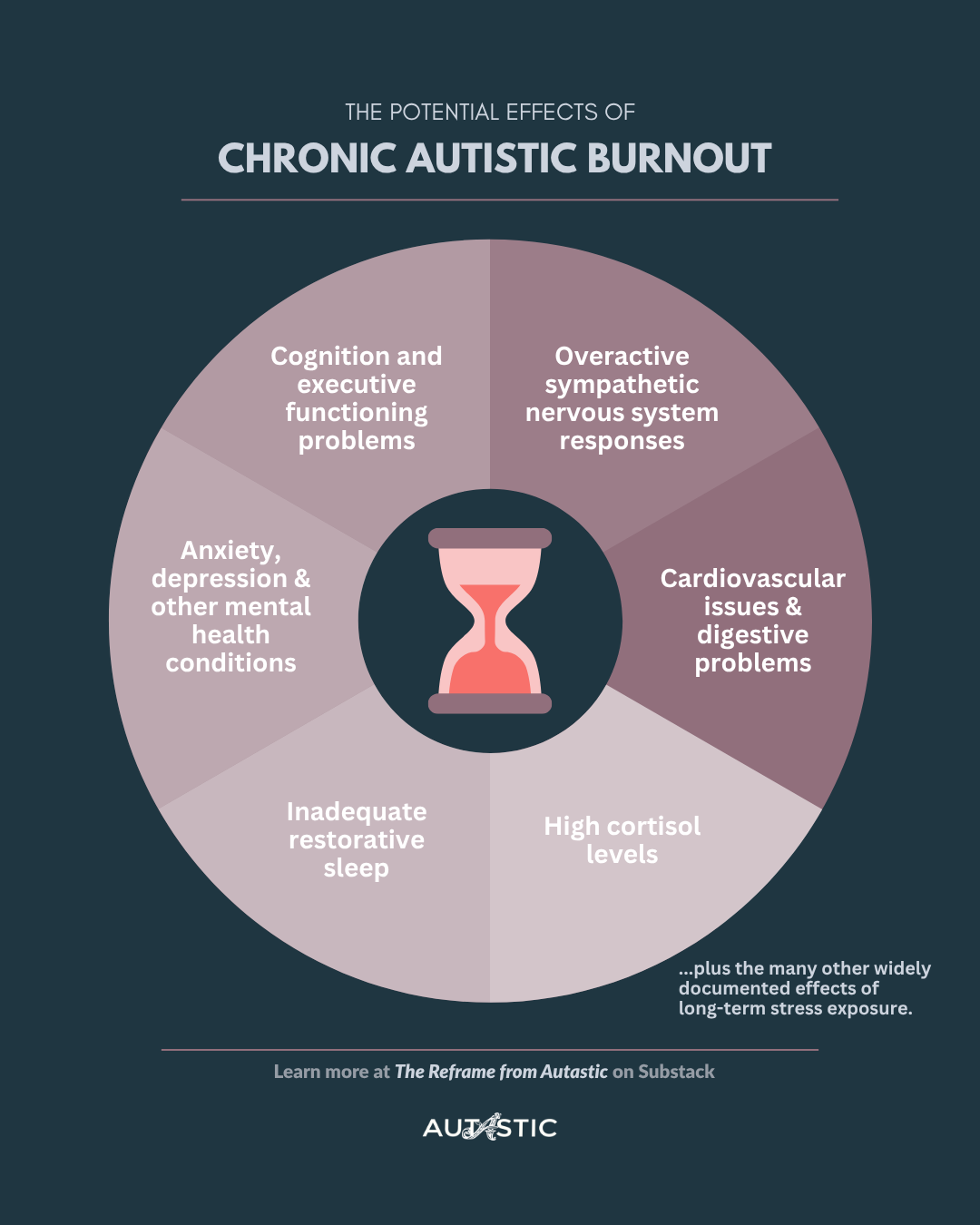
We’re not just tired. We are mentally and physically depleted.
👥👥 The price collectively:
Workplace productivity loss and increased sick leave—many of us are forced to use sabbaticals as periodic life-saving measures.
Increased healthcare and prescription use—including those related to misdiagnoses—with fewer positive outcomes.
Rising insurance and prescription costs, many from misdiagnoses.
Escalating reliance on pain-relieving substances and coping behaviors.
The many unseen costs of households struggling without adequate disability supports.
As PTSD and C-PTSD are widely recognized, taken seriously, and treated, so too should be Chronic Autistic Burnout.
🗝️ Think of it like this: Post-Traumatic Stress Disorder (PTSD) describes discrete traumatic events. Complex Post-Traumatic Stress Disorder (C-PTSD) describes prolonged, repeated, inescapable trauma. Chronic Autistic Burnout (CAB) describes the effects that accumulated ongoing stress leaves in our bodies, minds, and spirits as we age.
As PTSD and C-PTSD are widely recognized conditions that are taken seriously and treated, so too should be CAB.
The thousand cuts
To begin to rebuild, we first need a good grasp of the many relentless pressures and obstacles autistic people survive:
Sensory Overload. Inhospitable environments (which basically are most public spaces) force autistic sensory systems to operate outside our comfort zone most of the time, depleting our energy reserves just to exist.
Masking, aka “camouflaging”, aka “adaptive morphing”6 is “a trauma response to stigma, invalidation and marginalisation”.7 The more energy we’re made to expend through masking in ableist situations, the greater the accumulated future cost.
Being overworked by society because infrastructure provides support for allistic needs, not ours. Autistic cognition is all about details and direct engagement. We attend to each part rather than skipping steps. Without external scaffolding to support that process, we end up doing far more mental and emotional labor than most people ever see.
Surviving the lack of support for autistic people across our life stages takes its toll. Finding/holding/losing jobs, raising families, taking care of our elders, being elders, and all of that expected life stuff accomplished with allistic standards in mind means that we push ourselves, our bodies and brains beyond capacity repeatedly over time.
Surviving ableism, the nearly invisible bias that’s baked into societies worldwide that shapes every autistic life, masked or not. Negative consequences for not meeting expectations and standards are real, not innate perfectionist tendencies.
Surviving racism. Despite Black, Indigenous, Pacific Islander, Asian and Southwest Asian, Latine, North African, and other peoples of the African and global diasporas forming the majority, racism affects our daily lives because most every place on earth has been, and continues to be, shaped by the legacies of colonization. As noted above, because colonization and ableism are deeply entwined, recovery can’t rely on willpower or individual effort alone. Recovery depends on collective care and conditions that let us heal within the world as it is.
Surviving systemic prejudices against the many identities each of us hold as parents, siblings, children, co-workers, friends, strangers in public places, queer people, trans people, gender-expansive people, people of color, and more.
Surviving erasure makes us have to constantly justify our needs and our existence, often being invalidated because of widespread misinformation. Black and brown autistic people are exponentially erased due to lack of information about us, lack of inquiry, lack of data, lack of policy and infrastructure, and lack of representation of autistic people who aren’t of the dominant culture. #WeExist.
The double-bind of identity. If you’re BIPOC, you’re further caught in an exhausting generational double-bind: pay the cost for being autistic (hello ableism) or pay the cost for being Black or brown (hello racism). What’s that? You’ve paid both? Yup, me too.
Tired yet? But wait, there’s more. Add on economic precarity and poverty for a large percentage of us, medical gaslighting and trauma, gendered expectations and sexism, bullying and violence, carceral systems, social disconnection, internalized ableism, conditioned self-doubt, presumed incompetence, and loss of agency and it’s easy to see why getting a new time management app isn’t it when it comes to healing from Chronic Autistic Burnout.
🤿 Consider reviewing the above points again making notes of one or two ways each shows up in your life. Laying out the full onslaught for your inspection is a great first step to recovery.
🗓️ Next time…
Next time we’ll get into practical actions you can use to start and sustain ongoing recovery from Chronic Autistic Burnout.
If you’re struggling right now and feel as if you’ve been living with a low battery forever, there is a way forward. It’s going to take effort you might not feel right now but even the tiniest steps count.
That there are people—so many people—who are in it with you. Even if all you can muster is to lurk on social media and watch advocate videos from under your weighted blanket, that’s self-care and that’s a start.
🗣️ How are you doing?
Now that we’ve talked more about the depth and breadth of Chronic Autistic Burnout and its sources, let’s talk👇🏽
If you’re in Chronic Autistic Burnout now, what’s been the most difficult part?
If you recently realized for the first time that you’re in autistic burnout, what would be the most helpful thing right now, big or small?
If you’re 50 and over, what do you want younger autistic people to know about the long tail of masking and Chronic Autistic Burnout?
Share in the comments or in our Autastic communities.
If you find The Reframe from Autastic makes a difference in your life, I’d could do wonders with your support. Leave a comment to let me know how these words resonated with you, share this post with a friend, upgrade your subscription, or donate. You and I can change the world, one life at a time 💛🧡💚
Need autistic BIPOC community? Come on over to Autastic 💪🏽💪🏾💪🏿

Just one of many scholars on the subject: Sloan, Will. “Reckoning with Ableism and Colonialism.” Toronto Metropolitan University (TMU), 20 July 2018.
Raymaker, Dora M., et al. “‘having all of your internal resources exhausted beyond measure and being left with no clean-up crew’: Defining autistic burnout.” Autism in Adulthood, vol. 2, no. 2, 1 June 2020, pp. 132–143, https://doi.org/10.1089/aut.2019.0079.
Malone, Kayla M., et al. “The scholarly neglect of black autistic adults in autism research.” Autism in Adulthood, vol. 4, no. 4, 1 Dec. 2022, pp. 271–280, https://doi.org/10.1089/aut.2021.0086.
Jones, Sandra C, et al. “Representation of autism in fictional media: A systematic review of media content and its impact on viewer knowledge and understanding of autism.” Autism, vol. 27, no. 8, 19 Feb. 2023, pp. 2205–2217, https://doi.org/10.1177/13623613231155770.
Arnold, Samuel RC, et al. “Confirming the nature of Autistic Burnout.” Autism, vol. 27, no. 7, 13 Jan. 2023, pp. 1906–1918, https://doi.org/10.1177/13623613221147410.
Pearson, Amy, and Kieran Rose. “A Conceptual Analysis of Autistic Masking: Understanding the Narrative of Stigma and the Illusion of Choice”. Autism in Adulthood, vol. 3, no. 1, 1 Mar. 2021, pp. 52–60, https://doi.org/10.1089/aut.2020.0043.
Rose, Kieran. “Autistic Masking.” The Autistic Advocate, 13 Sept. 2025.